Comprehensive Sewer Line Repair and Trenchless Replacement in Plantation, FL
The sanitary sewer lateral connecting your residential or commercial plumbing fixtures to the City of Plantation municipal sewer main represents one of the most critical structural components of your property. Buried beneath concrete slab foundations, manicured landscaping, driveways, and sidewalks, these four-inch to six-inch drainage lines carry thousands of gallons of wastewater away from your home daily. When a sewer pipe cracks, collapses, or rots out, the consequences are devastating: recurring fixture backups, noxious sewer gas odors inside living areas, contaminated groundwater, and sinking foundation soil.
At Plumbing Plantation, our partner technicians specialize in modern non-invasive sewer rehabilitation. Rather than immediately resorting to catastrophic excavation—jackhammering through finished ceramic tile flooring, hardwood, and landscaped patios—we utilize advanced trenchless technologies including Cured-In-Place Pipe (CIPP) epoxy lining and pneumatic pipe bursting. These proven structural repair methodologies restore your sewer line to code-compliant condition with a lifespan exceeding fifty years while preserving your home finishes.
Whether you own an established 1970s single-family home in Jacaranda suffering from cast iron deterioration, a ranch property in Plantation Acres facing extensive tree root intrusion, or a commercial building along Peters Road, our network delivers precision sewer engineering. Review our comprehensive plumbing services catalog, explore our coverage throughout neighboring Broward cities, or consult our cast iron pipe replacement guide to evaluate rehabilitation strategies for your property.
Causes of Sewer Lateral Failures in Plantation, Florida
Sewer pipes in Central and Western Broward County endure extreme environmental and structural stressors that drastically shorten their operational lifespans:
Primary Drivers of Sewer Failure in Plantation Properties:
- 1. Subtropical HumiditySewer Gas: Sulfuric acid eats bottom channel out of cast iron pipes
- 2. High Water TableSoil Shifting: Sub-slab settling shears rigid clay and PVC couplings
- 3. Aggressive Root Systems: Ficus and live oak roots penetrate joints seeking constant moisture
- 4. Heavy Traffic Vibration: Slabs and driveways transmit vehicle loads cracking shallow lateral
1. Cast Iron Bottom Channel Rot
The majority of homes constructed throughout Plantation prior to the mid-1980s utilized cast iron drainage piping. Under South Florida's warm, humid conditions, bacteria inside sewage produce hydrogen sulfide gas. When this gas combines with atmospheric moisture inside the upper half of the pipe, it condenses into sulfuric acid that slowly trickles down the interior walls, pooling in the bottom channel. Over thirty to fifty years, this chemical erosion carves a deep trench along the pipe floor until the bottom completely disintegrates. Water then washes away supporting soil beneath your slab, creating voids and catastrophic clogs.
2. Aggressive Subtropical Tree Root Penetration
Plantation is renowned for its lush tree canopies, characterized by sprawling live oaks, ficus trees, and royal palms. The root structures of these species are remarkably aggressive, seeking subterranean moisture during Florida's dry winter season. Microscopic root hairs penetrate loose pipe couplings, hairline fissures, and cleanout fittings. Once inside, the roots feed on organic waste, expanding into massive fibrous mats that catch solid waste and completely obstruct wastewater flow.
3. Shifting Sub-Slab Soils and Ground Settling
The geology of Plantation consists of sand and porous limestone over a shallow water table linked to the Biscayne Aquifer. During heavy tropical storm seasons, saturated soils expand, contract, and shift. This physical movement places severe shear stress on rigid pipe joints. In older systems, this causes pipe sections to dislodge, drop, or create reverse slopes ("bellies") where water stands stagnant.
Sewer Repair Technologies Compared: Trenchless Lining vs. Traditional Excavation
When repairing a damaged sewer lateral, property owners historically faced disruptive excavation that destroyed living rooms, kitchens, and yards. Today, trenchless CIPP structural lining provides an exceptional alternative in the majority of cases. The comparison table below highlights key differences between modern trenchless restoration and traditional open-trench replacement:
| Technical Dimension | Cured-In-Place Pipe (CIPP) Lining | Traditional Open-Trench Excavation |
|---|---|---|
| Structural Destruction | Zero interior excavation; access via small exterior cleanout | Jackhammering interior floors, trenching through lawn and driveway |
| Installation Timeline | Typically completed in 1 to 2 days | Often requires 1 to 2 weeks of excavation and restoration |
| Finished Pipe Structure | Seamless, jointless structural epoxy sleeve inside host pipe | New Schedule 40 PVC pipe sections joined by mechanical couplings |
| Root Intrusion Resistance | 100% impervious to roots (no seams or joints) | High resistance; joints can be vulnerable if soil shifts |
| Expected Lifespan | 50+ Years (exceeds ASTM F1216 standards) | 50+ Years (Schedule 40 PVC) |
| Secondary Restoration Costs | Zero flooring replacement, minimal landscape restoration | High flooring, drywall, paver, and landscape replacement costs |
| PermitInspection Approval | Approved under Florida Building Code (Plumbing 8th Edition) | Approved under Florida Building Code (Plumbing 8th Edition) |
The 4-Stage CIPP Trenchless Lining Process
Cured-In-Place Pipe lining transforms your deteriorated cast iron or clay sewer line into a brand-new, structural pipe without digging up your home or yard:
4-Stage CIPP Trenchless Restoration Workflow:
- Stage 1: High-Definition Camera Audit: Measure internal diameter, map branches and breaks
- Stage 2: Mechanical DescalingJetting: High-speed chain flails remove rust and scale buildup
- Stage 3: Epoxy Liner Inversion: Seamless felt tube saturated with structural epoxy pulled in place
- Stage 4: CuringRobotic Branch Reinstatement: Epoxy cures hard; robotic cutter restores drains
Stage 1: Detailed High-Definition Video Inspection
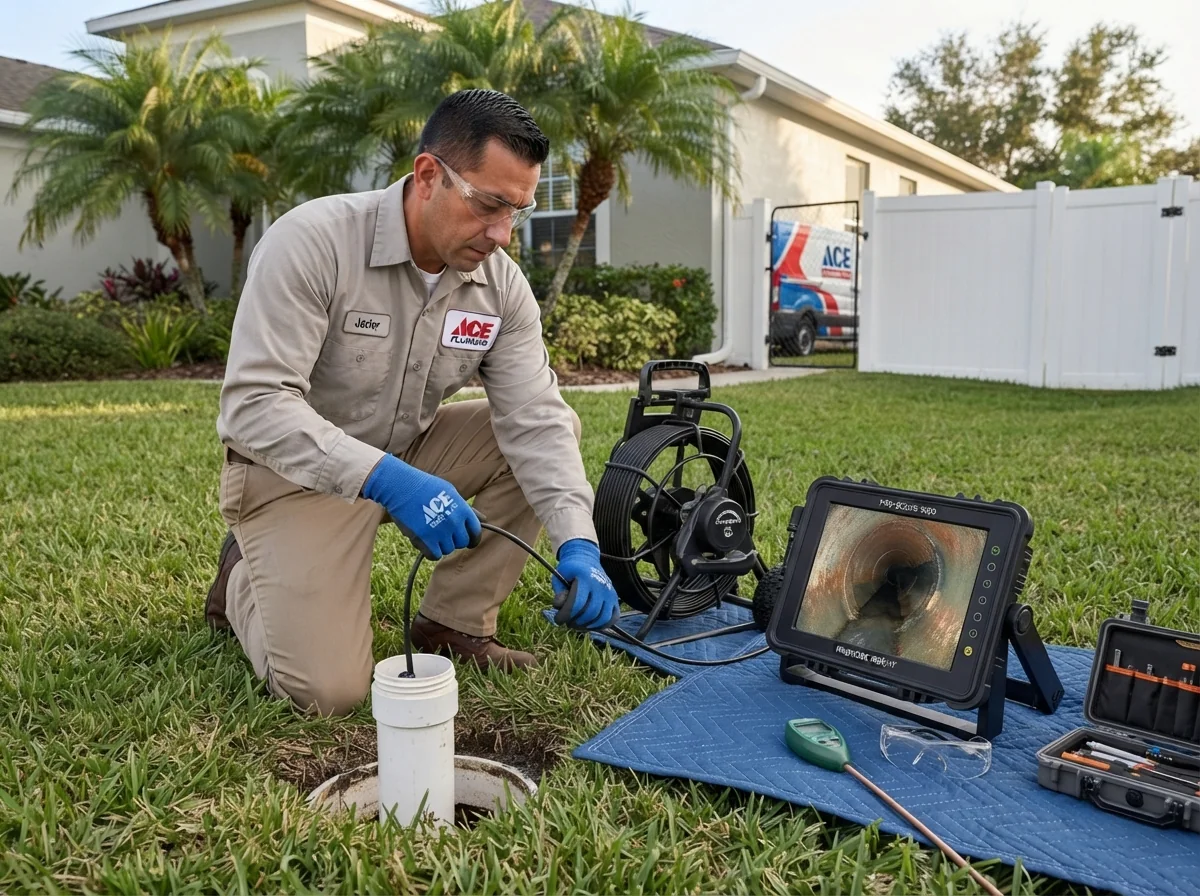
Technicians insert a self-leveling color camera into the main sewer cleanout to inspect every linear foot of the lateral. Using integrated radio sondes, we pinpoint the exact depth, transitions, and connection points where individual branch drains tie into the main line.
Stage 2: Mechanical Descaling and Hydro Jetting
Before inserting the structural liner, the interior of the host pipe must be thoroughly prepared. Technicians run high-speed motorized chain knockers and high-pressure hydro jetting equipment through the line. This scours away decades of accumulated rust scale, tuberculation, and calcified deposits, restoring the original circular cross-section of the pipe.
Stage 3: Structural Epoxy Liner Inversion
A seamless tubular felt liner customized to the exact length and diameter of your pipe is thoroughly saturated ("wetted out") with high-grade, two-part epoxy resin under vacuum. Using pneumatic pressure, the saturated liner is inverted into the host pipe from an exterior cleanout. The liner expands tightly against the interior walls of the old pipe, filling cracks and bridging rotted channels.
Stage 4: Thermal Curing and Robot Branch Reinstatement
The epoxy resin cures through an ambient or steam-assisted chemical process, hardening into a jointless, ultra-smooth structural pipe-within-a-pipe that is impervious to root penetration and chemical attack. If interior branch drains tie into the main lateral along the lined section, technicians introduce a micro-robotic cutter guided by an inline camera to precisely reopen those connections from the inside.
When Is Traditional Excavation Necessary?
While trenchless lining is ideal for pipes suffering from internal channel rot, fissures, or root intrusion, there are specific structural conditions where traditional open-trench replacement is required:
- Complete Pipe Collapse: If an underground pipe has experienced total structural collapse and crushing, a liner cannot be pulled through the void. Excavation is necessary to physically remove the crushed segment.
- Severe Reverse Slope ("Sewer Belly"): If shifting soil has caused a pipe section to drop severely, creating a deep standing water depression, trenchless lining will simply mirror the existing low spot. Excavation is required to re-grade the trench with compacted bedding stone to re-establish proper gravity pitch.
- Severe Offset Joints: When separated pipe segments have shifted out of horizontal alignment by more than forty percent, physical realignment through targeted excavation is necessary.
In these instances, our partner technicians utilize surgical excavation techniques, cutting narrow, precise trenches and employing shoring equipment to minimize property disruption.
Clear Project Estimates and Ethical Service Standards
Major sewer repairs represent a significant investment in your property's long-term value. Our platform strictly adheres to transparent business practices:
- On-Site Video Verification: We show you the actual camera inspection footage of your sewer line, explaining the exact defects and failure mechanisms before discussing repair options.
- Itemized Written Estimates: You receive a comprehensive written estimate detailing whether your system requires targeted spot repair, whole-line trenchless CIPP lining, or open-trench replacement.
- Clean-Tech Property Care: Technicians protect your grounds with heavy protective ground mats, maintain clean jobsites, and restore exterior turf upon completion.
- Florida Code Compliance: All sewer repairs conform strictly to the Florida Building Code (Plumbing 8th Edition 2023) and municipal regulations enforced by the City of Plantation Department of Building Safety (401 NW 70th Terrace, Plantation, FL 33317).
For complete budgeting comparisons, consult our drain cleaning and sewer repair cost guide or review our plumber cost guide in Plantation, FL.
Frequently Asked Questions About Sewer Line Repair
How long does a trenchless epoxy sewer liner last?
CIPP epoxy liners manufactured to ASTM F1216 specifications are engineered to exceed a fifty-year structural lifespan. Because the epoxy material is completely impervious to hydrogen sulfide oxidation and contains zero mechanical joints, it cannot rust, rot, or suffer root intrusion.
Will trenchless pipe lining reduce the flow capacity of my sewer line?
Although the epoxy liner slightly reduces the internal diameter of the pipe by roughly one-quarter of an inch, its ultra-smooth, slick surface significantly reduces hydraulic friction compared to rough, corroded cast iron. In fact, total wastewater flow velocity typically increases by up to fifteen percent post-lining.
Do I need a city permit for sewer line replacement in Plantation?
Yes. The Florida Building Code and the City of Plantation Department of Building Safety require permits for all major sewer repairs and replacements. This ensures that proper pipe slope, cleanout access, and ASTM-compliant materials are utilized, protecting your home's structural safety and real estate title.
What are the earliest warning signs of an impending sewer lateral failure?
Early indicators include multiple fixtures draining slowly at the same time, persistent gurgling noises from toilets when showers drain, foul sewer gas odors in bathrooms or near outdoor cleanouts, and unusually lush, green patches of grass above the sewer line path.
Connect With Our Plantation Sewer Specialists
Do not wait for an aging sewer lateral to collapse completely and flood your home with raw sewage. Connect with experienced, professional sewer repair specialists equipped with high-definition diagnostic cameras and proven trenchless lining technology.
Call our Plantation dispatch desk today at (954) 766-1469 to schedule an on-site video sewer evaluation, or submit an estimate inquiry online through our contact page. We are committed to restoring the structural integrity of your plumbing system.