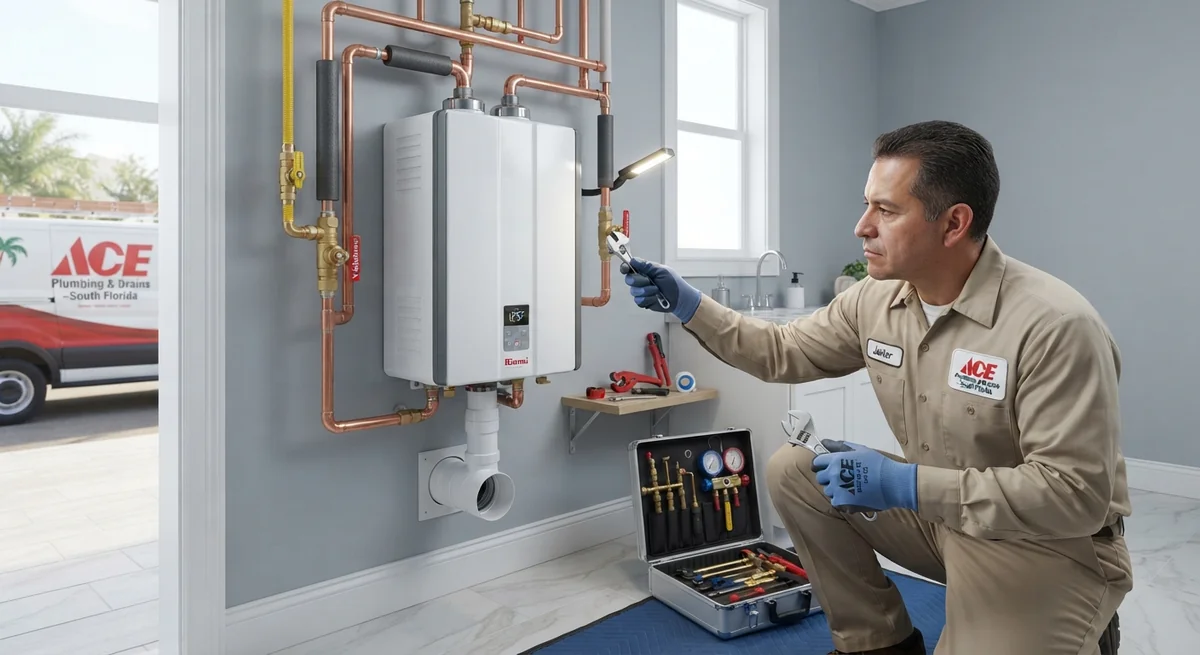
Professional Water Heater Replacement and Installation in Plantation, FL
When a residential or commercial water heater reaches the end of its operational lifespan—typically between eight and twelve years in South Florida's mineral-rich environment—replacing the unit with a modern, high-efficiency system is one of the most effective investments you can make in your property. A failing water heater not only risks catastrophic tank bottom rupture and indoor flooding, but also consumes excessive electrical energy due to heavy calcium scale encrustation insulating the heating elements.
At Plumbing Plantation, our partner technicians specialize in comprehensive water heater replacement and turnkey installation. From standard atmospheric electric storage tanks to high-output natural gas systems, energy-saving hybrid heat pump water heaters, and continuous-flow tankless conversions, our network delivers code-compliant installations engineered to withstand South Florida water conditions. Every replacement includes complete removal and recycling of your old equipment, installation of code-mandated thermal expansion controls, heavy-duty emergency drain pans, hurricane-rated seismic strapping, and full municipal permitting through the City of Plantation Department of Building Safety.
Whether you are updating a utility closet in Jacaranda, modernizing a custom estate home in Plantation Acres, or replacing a multi-unit array in Central Park, our network provides clear project estimates and flawless execution. Explore our complete catalog of residential and commercial plumbing services, review our coverage across neighboring Broward cities, or consult our water heater replacement cost guide for detailed equipment pricing benchmarks.
Water Heating Technologies Compared: Storage Tank vs. Tankless vs. Hybrid Heat Pump
Choosing the ideal water heater architecture requires evaluating household hot water demand, utility availability (natural gas vs. electric), electrical service panel capacity, and long-term energy reduction goals. The comparison table below highlights the performance metrics of the three primary water heating architectures installed across Plantation:
| Water Heater System Type | Typical Capacity | Expected Lifespan in Plantation | Energy Efficiency (UEF) | Standby Energy Loss | Upfront Installation Investment |
|---|---|---|---|---|---|
| Standard Electric Storage Tank | 40 to 80 Gallons | 8 to 12 Years | 0.92 to 0.95 UEF | High (Continuous heating 24 hours/day) | Moderate (Straightforward changeout) |
| High-Efficiency Tankless (Gas/Electric) | Continuous Flow (5 to 11 GPM) | 15 to 20+ Years | 0.82 to 0.96 UEF | Zero (Heats water strictly on demand) | Higher (May require electrical/gas upgrade) |
| Hybrid Heat Pump Water Heater | 50 to 80 Gallons | 12 to 15 Years | 3.50 to 4.00+ UEF | Ultra-Low (Absorbs ambient garage heat) | Moderate-High (Qualifies for federal tax credits) |
| Atmospheric Natural Gas Storage Tank | 40 to 50 Gallons | 8 to 12 Years | 0.60 to 0.70 UEF | Moderate (Vented through roof stack) | Moderate (Requires active gas utility line) |
Deep Dive: Tankless Water Heater Conversion in South Florida
For growing families and luxury properties throughout Plantation, transitioning from a conventional storage tank to an on-demand tankless water heater offers compelling benefits: unlimited continuous hot water, a compact wall-mounted footprint that frees up valuable closet or garage space, and an operational lifespan exceeding twenty years.
4 Critical Engineering Prerequisites for Tankless Conversion in Plantation:
- 1. Electrical Capacity: Whole-home electric tankless requires 120A-150A dedicated panel capacity
- 2. Gas Supply Line Sizing: Natural gas units require 3/4-inch to 1-inch lines (150K-199K BTU)
- 3. High-Velocity Hurricane Venting: Category IV stainless steel or PVC/CPVC exterior penetrations
- 4. Scale Prevention: Point-of-entry water treatment to protect narrow copper heat exchangers
1. Dedicated Electrical Service Sizing
Standard storage water heaters operate on a single 30-amp, 240-volt circuit. In contrast, whole-home electric tankless water heaters require massive electrical current—often drawing 120 to 150 amps across two or three dedicated double-pole breakers. Before recommending an electric tankless system, our partner technicians verify that your main electrical service panel possesses at least 200 amps of total capacity.
2. Natural Gas Supply and Venting Requirements
For properties with natural gas utility service, gas tankless water heaters (such as Rinnai or Navien units) provide exceptional performance. These systems burn 150,000 to 199,000 BTUs during peak operation, requiring dedicated three-quarter-inch or one-inch gas supply lines. Furthermore, under Broward County's High-Velocity Hurricane Zone (HVHZ) building codes, direct-vent intake and exhaust flues must feature wind-rated exterior terminations sealed against heavy driving rain.
3. Hard Water Descaling Protocols
Because tankless heat exchangers feature tightly wound copper or stainless steel water channels, South Florida's mineral-rich water can cause rapid scale accumulation if left unmanaged. Our technicians install specialized isolation service valves on every tankless installation, allowing straightforward annual flushing with food-grade descaling solutions to maintain peak thermal efficiency and factory warranty protection.
Hybrid Heat Pump Water Heaters: The Ideal Solution for Florida Garages
In South Florida's warm climate, hybrid heat pump water heaters represent the most energy-efficient water heating technology available today. Rather than generating heat directly through electric resistance elements, a heat pump absorbs heat from the surrounding air and transfers it into the water tank using an environmentally friendly refrigerant cycle.
Why Hybrid Heat Pump Water Heaters Excel in South Florida Garages:
- Advantage 1: Up to 70% Energy Reduction: Uses ambient 85°F-95°F garage air to heat water
- Advantage 2: Garage Dehumidification: Exhausts cool, dry air (roughly 65°F), lowering humidity
- Advantage 3: Substantial Rebates: Qualifies for federal Section 25C clean energy tax credits
- Advantage 4: Extended Service Life: Hybrid operation reduces continuous strain on elements By leveraging the ambient heat naturally present in Plantation garages for ten to eleven months of the year, hybrid systems cut annual water heating utility expenses by hundreds of dollars while keeping garage spaces cooler and drier.
City of Plantation Permitting and Code Compliance Standards
Water heater replacements conducted within the City of Plantation are governed by the Florida Building Code (Plumbing 8th Edition 2023) and local municipal safety requirements. The City of Plantation Department of Building Safety (located at 401 NW 70th Terrace, Plantation, FL 33317) mandates that all water heater changeouts receive an official plumbing permit and undergo a post-installation municipal inspection.
Mandatory Florida Building Code Safety Components Included on Every Installation:
- 1. ASME-Rated T&P Relief Valve: Discharges through dedicated full-bore copper/CPVC line to floor
- 2. Thermal Expansion Tank: Pre-pressurized to absorb closed-loop municipal pressure surges
- 3. Heavy-Gauge Aluminum Drain Pan: Minimum 1.5-inch depth plumbed to exterior or approved drain
- 4. Hurricane Tie-Down Straps: Heavy galvanized straps securing tank against seismic/wind shift
- 5. Accessible Electrical Disconnect: Quick-disconnect switch or lockout within sight of heater
Why Certified Permitting Protects Property Owners:
- Fire and Explosion Protection: Municipal building inspectors verify that pressure relief valves, discharge lines, thermal expansion tanks, and electrical disconnects are correctly sized, eliminating catastrophic pressure hazards.
- Insurance Policy Validity: If an unpermitted water heater ruptures and causes thousands of dollars in water damage, Florida insurance underwriters can deny coverage on the grounds that work was performed outside municipal building safety codes.
- Smooth Real Estate Closings: In Broward County, title searches routinely flag unpermitted mechanical replacements, which can stall mortgage underwriting or require emergency retroactive permitting fees during real estate sales.
Our service network handles every phase of the permitting workflow—from initial plan submittal to coordinating the final walk-through with city inspectors—ensuring documented safety and compliance.
Our Turnkey Replacement Workflow
Replacing a water heater should be a seamless, stress-free experience. Our partner technicians follow a standardized 5-step installation procedure:
Step 1: In-Home Assessment and Sizing Analysis
Your technician assesses your household's peak hour hot water demand (FHR), checks incoming water pressure, evaluates existing electrical or gas infrastructure, and measures physical utility closet dimensions to recommend properly sized models.
Step 2: Safe Decommissioning and Removal
We shut off incoming water, de-energize electrical breakers, drain the old tank completely, disconnect piping and venting, and carefully transport the old equipment out of your home using protective hand trucks and floor runners. The old tank is responsibly recycled.
Step 3: Mechanical and Safety Upgrades
We position a new heavy-duty aluminum drain pan, mount the new unit, secure heavy galvanized hurricane tie-down straps, install a new ASME-rated temperature-and-pressure relief valve, plumb full-bore discharge piping, install a calibrated thermal expansion tank, and connect ball-style quarter-turn shutoff valves with stainless steel braided flex connectors.
Step 4: System Pressurization and Commissioning
The tank is filled with water, all air is bled from household hot water lines, and plumbing joints are thoroughly inspected for leaks. Only once the tank is 100% full is electrical power restored. Technicians test element heating cycles, calibrate thermostats to a safe 120 degrees Fahrenheit, and measure operating amperage with digital meters.
Step 5: Clean-Tech Cleanup and City Permitting
Technicians clean the entire work area, review operational controls and maintenance procedures with you, place permit documentation in the mechanical envelope, and coordinate municipal inspection walk-throughs with the City of Plantation.
Clear Project Estimates and Ethical Service Standards
Water heater replacement should never involve hidden surcharges, surprise delivery fees, or vague quotes. Our platform strictly adheres to transparent consumer standards:
- Comprehensive Written Estimates: You receive a detailed written estimate outlining equipment brand, model number, gallon capacity, energy efficiency rating, all installation labor, code-required safety components, and municipal permit fees before physical work begins.
- Clean-Tech Property Care: Technicians wear sanitized protective boot covers, roll out heavy floor runners, and protect your living spaces throughout the installation process.
- Budgeting Disclosure: Published cost figures are intended for budgeting purposes only. Because physical piping accessibility, material grades, and municipal requirements differ on every property, final pricing is confirmed on-site prior to work.
Review our in-depth water heater replacement cost guide or consult our plumber cost guide in Plantation, FL for complete regional price benchmarks.
Frequently Asked Questions About Water Heater Replacement
How long does a water heater typically last in Plantation, FL?
Due to high water mineral content and elevated ambient temperatures, standard electric storage water heaters in Broward County typically last between eight and twelve years. Water heaters installed in hot, unconditioned garages often experience accelerated tank bottom corrosion compared to indoor units. Tankless water heaters with routine descaling can achieve lifespans exceeding twenty years.
How do I know what size water heater my home needs?
Sizing is based on your household's peak-hour demand—the maximum volume of hot water required during the busiest hour of the day (e.g., morning showers, dishwashing, and laundry running concurrently). A standard two-bathroom home typically requires a 50-gallon electric storage tank (First Hour Rating of 60 to 70 gallons) or a tankless unit producing 7.5 to 9.5 gallons per minute.
Can I replace my water heater myself without a city permit?
Under Florida law and City of Plantation municipal codes, water heater replacements require a building permit and must be performed in accordance with the Florida Building Code (Plumbing 8th Edition 2023). Unpermitted self-installations create serious electrical, fire, and scalding hazards, and can void your homeowners insurance policy in the event of tank rupture or water damage.
What should I do if my water heater is currently leaking from the bottom?
A leak originating directly from the bottom of the steel tank indicates that the internal glass lining has cracked and the outer jacket has corroded through. Shut off the cold water supply valve immediately, turn off the dedicated electrical breaker, and call our emergency dispatch line at (954) 766-1469 to schedule immediate replacement before the tank bursts completely.
Connect With Our Plantation Water Heater Specialists
Do not wait for an aging, sediment-clogged water heater to burst and flood your living space. Upgrade to a modern, energy-efficient, code-compliant water heating system that delivers dependable hot water and lower monthly utility bills.
Call our Plantation dispatch desk today at (954) 766-1469 to schedule an on-site consultation and clear project estimate, or submit an estimate request online via our contact page. Let our experienced team provide the dependable water heating solutions your home deserves.